Read and Pass It On: The War Leaflet in the Yugoslav Region in the 20th Century
15.09.2026-31.03.2027
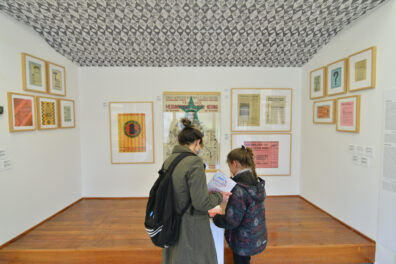
The Museum of Yugoslavia presents the exhibition “Read and Pass It On: The War Leaflet in the Yugoslav Region in the 20th Century,” dedicated to the war leaflet as one of the most widespread means of propaganda during the major wartime conflicts of the 20th century. The exhibition examines the ways in which systemic propaganda, as an integral part of wartime operations, changed with technological progress, as well as in relation to various political, economic and social contexts, conflicts and transformations. The exhibition will open on Tuesday, 15th September at 6 p.m., on the Day of Serbian Unity, Freedom and the National Flag, and will be open to the public until March 2027. The authors of the exhibition are historians Radovan Cukić (Museum of Yugoslavia) and Nemanja Kalezić (National Library of Serbia).
From the beginning of the 20th century, with the rapid development of printing and reproduction and distribution technologies, the leaflet became an important means of communication between the warring parties and the population. Its primary function was not objective information but rather influencing the attitudes and behaviour of its intended recipients – from demoralizing enemy soldiers and calling for surrender, to boosting the morale of one’s own population and spreading the notion of a certain wartime victory.
The exhibition “Read and Pass It On” traces the use of the leaflet through the armed conflicts that marked the history of the former Yugoslav region – from the First and Second World Wars to the wars over the Yugoslav succession during the 1990s. The material on display bears witness to the various propaganda strategies, methods of distribution and language used by different military, political and social sides to address their target groups.
“The leaflet is at the same time a historical document and a means of propaganda, which is why reading it requires particular caution. It is not created with the intention of faithfully describing events, but with the aim of having a psychological effect on the recipient – to frighten, encourage, persuade or incite them to act. This is precisely why we must consider its content and context together,” Radovan Cukić and Nemanja Kalezić, the authors of the exhibition, have said.
A special section of the exhibition is dedicated to the Second World War, when the leaflet was one of the key means of communication in occupied and war-affected territories. Through examples from Serbia, Montenegro, the Independent State of Croatia, Dalmatia and Istria, Slovenia and Macedonia, as well as through material from the Allied forces, the exhibition shows the extent to which the messages and the methods of their distribution were shaped by local political, military and social circumstances.
Although radio and television became the dominant mass media during the second half of the 20th century, the leaflet did not lose its function. Its use continued during the wars of the 1990s, including the wars in Croatia and Bosnia and Herzegovina, as well as the NATO bombing of the Federal Republic of Yugoslavia in 1999.
One of the themes of the exhibition is also the question of preserving this type of material. Unlike the poster, which, due to its format and visual expressiveness, has long been recognised as an important historical source, the leaflet has often been regarded as merely ephemeral material. Due to a lack of accompanying documentation, many surviving examples are today difficult to date chronologically, and the context of their creation remains unclear.
The concept, design and production of the spatial layout are by Studio Turbina, while the idea, design and graphic design of the exhibition display are the work of Katarina Keti Zaharijev.
The exhibition was made possible by the Ministry of Culture and Information of the Republic of Serbia. For their assistance in preparing the exhibition and lending material, the authors are grateful to: the Historical Museum of Serbia, the Belgrade City Museum, the Archives of the City of Belgrade, the Archives of Serbia, the Military Museum in Belgrade, the Military Archive in Belgrade, the Museum of Vojvodina, the National Museum in Zrenjanin, the Historical Archive of Sombor, the National Museum of Valjevo, the National Museum of Užice, the National Museum of Šumadija in Kragujevac, the National Museum of Aranđelovac, the Inter-Municipal Historical Archive in Čačak, the Serbian House in Corfu, the Museum of Contemporary History of Slovenia, the Museum of National Liberation Maribor, the Croatian History Museum, the Croatian Memorial-Documentation Centre of the Homeland War, the Rijeka City Museum, the Maritime and History Museum of the Croatian Littoral in Rijeka, the State Archive in Rijeka, the Historical and Maritime Museum of Istria in Pula, the State Archive in Pazin, the Homeland War Museum Dubrovnik, the National Museum of Montenegro, the State Archive of Montenegro, the State Archive of North Macedonia, the Museum of North Macedonia, the Historical Archive of Bitola, the National Museum of Military History of Bulgaria, the “Politika” printing house, Nemanja Baćković, Branko Lovrić, Goran Davidović and Mario Hrelja.
The exhibition will be open until March 2027.
The Origins: The Background for Understanding the Museum of Yugoslavia
Creation of a European type of museum was affected by a number of practices and concepts of collecting, storing and usage of items.
New Mappings of Europe
Museum Laboratory
Starting from the Museum collection as the main source for researching social phenomena and historical moments important for understanding the experience of life in Yugoslavia, the exhibition examines the Yugoslav heritage and the institution of the Museum