A Short Biography of Veljko Vlahović
The biography of Velimir Veljko Vlahović (1914–1975) takes us through some of the key political and social turmoils of the 20th century — from the student protests of the 1930s, through the Spanish Civil War and World War II, to the formation of socialist Yugoslavia and its positioning in the world during the Cold War. Vlahović’s life connects the experiences of illegal revolutionary work, wartime engagement, international diplomacy and political activity, offering to us a series of crucial events of the history of Yugoslavia, but also of the wider Europe, through the biography of one political actor.
Veljko Vlahović was born on December 23, 1914, in Trmanje, near Kolašin, into a family with a history of wars and uprisings experiences. His mother, Mijojka, was the daughter of a Montenegrin commander Bećo Zuletin, a bearer of the Cross of Saint George, the highest Russian imperial decoration. His father Milinko Vlahović (1881–1930), a captain of the Army of the Kingdom of Montenegro, led the Rovački Battalion in the Battle of Mojkovac, was a duke of the Toplica Uprising, and a lieutenant colonel of the Yugoslav Army. The family tradition of freedom fighting continued into World War II — Veljko Vlahović’s sisters and brothers participated in the uprising from its inception, and his two brothers, Branko and Dušan, were killed as prominent participants of the National Liberation Struggle.

Veljko Vlahović as a school student, 1920s
National Museum of Montenegro, Cetinje
Vlahović’s childhood and school days were marked by frequent relocations. Although he was born in Montenegro, he attended primary school in the village of Vlahovići, in Podgorica and Banja Luka, and the high school in Požarevac and Belgrade, where he began his studies in engineering. Already in 1933, he joined League of Communist Youth of Yugoslavia (SKOJ) and became a member of the generation that consolidated the progressive student movement at the University of Belgrade. As the president of the Action Committee of Professional Student Associations, he participated in the struggle for university autonomy and better living conditions. During 1935, he was imprisoned in the Višegrad concentration camp established for students punished for their political activity. Due to a great pressure from the student community (students from all three universities in the Kingdom of Yugoslavia – Ljubljana, Zagreb and Belgrade – went on strike) and due to hunger strike of the imprisoned students, and the fact that parliamentary elections were approaching, the camp, modelled after the German and Italian concentration camps of the time, was disbanded two months after it had been established.

Veljko Vlahović with colleagues on student internship, Inđija, 1935
National Museum of Montenegro, Cetinje
In April 1936, a big student strike began at the universities of Belgrade, Ljubljana and Zagreb, and Vlahović had a significant role in it. On April 4, 1936, student Žarko Marinović was murdered, and this event has been commemorated to this day as the Student’s Day of the University of Belgrade. The strike ended on April 28, 1936, as the students’ demands were met, but Vlahović was prohibited to continue studies in Belgrade, and that was why he left for Prague.

Veljko Vlahović on Charles Bridge, Prague, November 1936
In Prague, in the student dormitory “Alexander College”, Yugoslav communist students used to gather: Ratko Pavlović, Branko Krsmanović and Lazar Udovicki were some of the most famous among them. In 1937, a group of 26 Yugoslav students set off from Prague to Spain to join the fighters defending the Republic. The French Communist Party organized their transport to the Pyrenees, and they crossed the mountain border on skis.

Veljko Vlahović at a skiing lesson in the Krkonoše Mountains
In Spain, Vlahović joined the Dimitrov Battalion, a unit operating within the International Brigades. His first war experience was in the Battle of Jarama in February 1937, when he got seriously wounded. His leg was amputated and he suffered a serious shoulder injury. During his recovery, he joined the Communist Party of Spain and became an editor of the Brigade’s newspaper “Dimitrovac”, which covered the war and international anti-fascist activities. In 1938, he retreated to France with other fighters, where members of the International Brigades were interned in camps.

Wounded Veljko Vlahović in Alicante in front of the house given to him by night watchman Pepe, 1937.
National Museum of Montenegro, Cetinje
* Pepe’s son was killed when Veljko got wounded. He buried his son and laid Veljko’s amputated leg next to him. As he liked Vlahović, and as he lost his son, he gave him the house.
In Paris in 1938, Vlahović met Josip Broz, the General Secretary of the Communist Party of Yugoslavia, who informed him that it had been decided that Vlahović would go to Moscow as the representative of SKOJ in the Youth Communist International. Vlahović spent the next six years in the Soviet Union. In 1941, after the uprising in occupied Yugoslavia, he launched the radio station “Free Yugoslavia”, as a response to the narratives of Yugoslav emigration, who attributed the successes of the National Liberation Struggle exclusively to the Chetnik movement. The radio station used media from Western countries as sources, as well as the Nazi and quisling press. Particularly valuable were excerpts from letters of German soldiers killed or captured on the Eastern Front, to whom brothers, comrades and relatives wrote from Yugoslavia, informing them about the treatment of the occupying army on the Yugoslav territory.

Handing over of the war flag to the Yugoslav Brigade in the USSR, March 12, 1944
Archives of Yugoslavia, Belgrade
During his stay in the USSR, Vlahović met Mira Vajnberger, who had moved from Slovenia to the USSR as a child with a family of political emigrants. Mira was a widow and from two previous marriages she had two daughters, Svetlana and Jelena, whom Vlahović adopted, and together they had two sons, Slobodan and Branko. Vlahović returned to Belgrade on a Soviet military plane in March 1945.

Veljko Vlahović and Aleksandar Ranković in Košutnjak, Belgrade, 1945
National Museum of Montenegro, Cetinje
The Central Committee of the Communist Party of Yugoslavia put him in charge of the agitation and propaganda work, and in June 1948 he was elected to the Central Committee of the Communist Party of Yugoslavia for the first time – and he would be elected for the rest of his life to the body. In the post-war period, he performed duties related to foreign affairs: Deputy Minister of Foreign Affairs of the FPRY (1951–1952), and head of the Yugoslav delegation at the UN General Assembly session in 1952. Later, as the director of the newspaper “Borba” he took on editorial duties (1953), and then political positions in Belgrade as the president of the City Committee of the League of Communists of Belgrade (1968–1970).

Veljko Vlahović with participants of the Conference for Women’s Social Activity, Zagreb, 1961
National Museum of Montenegro, Cetinje
After the Informbiro Resolution of 1948, Yugoslavia started redefining its foreign policy, becoming more open to cooperation with Western countries, while also trying to conceptualize a new, middle path on the international political scene, together with the countries of Africa and Asia. The Non-Aligned Movement was formally founded in 1961 at the First Belgrade Conference, bringing together 25 countries and 3 countries with the status of observers. The most prominent founding states were India, Egypt, Indonesia, Ghana and Yugoslavia, and numerous other participants from Asia and Africa – Iraq, Iran, Pakistan, Afghanistan, Ethiopia, Sudan, Tunisia, Algeria, Morocco, Sri Lanka, Burma (Myanmar), Cambodia and others, were jointly building a non-aligned foreign policy at that time. During the 1960s, Vlahović went to diplomatic missions in Asia to gain support for Yugoslavia’s non-aligned political course and was a member of the Yugoslav delegation at the founding conference held in Belgrade in 1961. During the preparations for this summit, Vlahović wrote diary notes that are kept at the National Museum of Montenegro (NMCG) in Cetinje, and which were published in 2021 under the title “Conference de Belgrade: dnevnički zapisi Veljka Vlahovića sa Beogradske konferencije 1961”. The editor of this publication is Božena Miljić, who, together with Ljiljana Karadžić, also authored the first exhibition about Veljko Vlahović – “On the Side of Justice and Freedom: The Legacy of Veljko Vlahović”, presented in 2018 at the National Museum of Montenegro.

Yugoslav delegation at the Belgrade Conference of the Non-Aligned Movement. In the photo: Josip Broz Tito, Edvard Kardelj, Vladimir Bakarić, Veljko Vlahović and Koča Popović, September 1-6, 1961
Museum of Yugoslavia
In 1968, Vlahović was among the students again, but this time as a representative of the authorities. Although the immediate cause of the 1968 demonstrations was a clash with the police when the participants of Youth Labor Actions were given priority over the students to enter a concert, the rebellion quickly took on a social character: the students were protesting against growing social stratification, and the most radical slogan that emerged was “Down with the Red Bourgeoisie”. When negotiations with students began on June 3, 1968, in New Belgrade, the delegation of government representatives included Veljko Vlahović, who was welcomed by the students with slogans such as “Veljko, Remember Spain” and “Veljko, Lead Us”. Another high-ranking official who participated in these negotiations was the then President of the Assembly of the People’s Republic of Serbia, Miloš Minić. Both Vlahović and Minić had participated in the student demonstrations of the 1930s, and that was why they were considered legitimate and trustworthy persons among the gathered students. The protest of 1968 was marked by police violence, when apart from students, some representatives of the state and party administration were injured, too. The demonstrations ended on June 9, 1968, after an address by President Josip Broz and the fulfillment of some of the students’ demands.

The Party’s political leadership (Veljko Vlahović, Miloš Minić, Branko Pešić, Miroslav Pečujlić, Simeon Zatezalo) comes to talk to students, 1968. Photo: S. Kragujević
Museum of Yugoslavia
Veljko Vlahović fell ill in 1973 and was treated in London, Belgrade and Geneva. After a successfully performed surgery in Geneva, he dined at his surgeon’s place, where he died on March 10, 1975. Already in May of the same year, a gusle epic poem “To Our Great Veljko Vlahović” was dedicated to him. It was performed by folk gusle player Vojo Radusinović. Thus, the freedom fighting virtues, aspirations and ideals of the veteran of the Spanish Civil War, the national hero of Yugoslavia and the hero of socialist labor, were concluded by the tradition from which he had emerged.

Funeral of Veljko Vlahović, Belgrade, 1975
Museum of Yugoslavia
At the exhibition “Veljko Vlahović, The Voice of a Free Yugoslavia”, you can see photographs from the funeral, as well as a copy of a daily “Borba”, which dedicated its cover pages, for three days, to the death and funeral of its former editor.
The legacy of Veljko Vlahović is kept in the National Museum of Montenegro in Cetinje, where the exhibition “On the Side of Justice and Freedom: The Legacy of Veljko Vlahović”, by Božena Miljić and Ljiljana Karadžić, was opened in 2018. The exhibition, with a slightly modified and supplemented concept, with materials from the Museum of Yugoslavia and the Archives of Yugoslavia, under the title “Veljko Vlahović – the Voice of a Free Yugoslavia”, opened at the Museum of Yugoslavia in May 2025 as the first biographical exhibition in this institution. The Museum of Yugoslavia’s team of authors comprise Dušica Stojanović and Ljubica Vlahović. The exhibition is open until February 1, 2026.

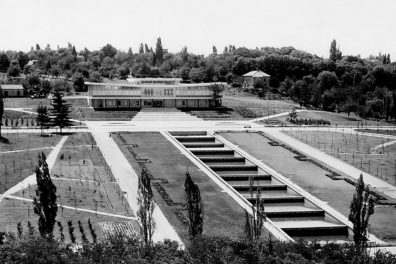
The Origins: The Background for Understanding the Museum of Yugoslavia
Creation of a European type of museum was affected by a number of practices and concepts of collecting, storing and usage of items.
New Mappings of Europe
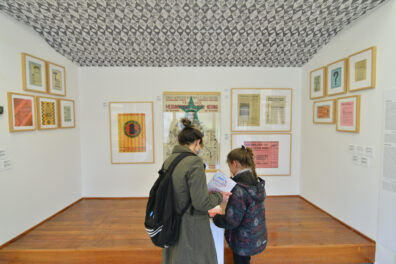
Museum Laboratory
Starting from the Museum collection as the main source for researching social phenomena and historical moments important for understanding the experience of life in Yugoslavia, the exhibition examines the Yugoslav heritage and the institution of the Museum