HOW FRANCE REMEMBERED THE YUGOSLAV KING ALEXANDER I KARADJORDJEVIĆ
The assassination of King Alexander I Karađorđević on October 9, 1934, in Marseille disturbed not only Yugoslavia but also France, whose officials faced a serious question of stability in interwar Europe. This tragic event paved the way for a complex memory practice in an attempt to preserve the memory of the king as a symbol of friendship between the two nations through art and monuments.
The assassination that took place in Marseille on October 9, 1934, when the Yugoslav king and the French minister were killed, poured onto the front pages of the newspapers, and was the first political assassination recorded by video camera. Shocked citizens in both countries, overwhelmed by the scenes of death and suffering, needed to regain a sense of stability. The bullets fired on October 9 in Marseille induced a period of immediate political crisis, which would turn into a period of long-term concern of French statesmen about the peace in interwar Europe, granted by the Paris Conference that had ended the Great War.
The dominant role of France on the international scene was increasingly fading, and Nazi Germany and Fascist Italy gradually came to the fore. It was important for the French Third Republic to keep strong relations with the former Balkan ally and decrease German influence in Southeast Europe. The ultimate goal of the foreign policy was to maintain the Versailles order. Real politics became more and more complicated, and symbolic politics came to the fore – promoted through images, monuments and other media of visual culture. It was supposed to fill the void in the political turmoil and show the right path.
The symbolism of the death mask of King Alexander I
The lifeless bodies of the Yugoslav King Alexander I Karađorđević and the French minister Louis Barthou were displayed in the prefecture building in Marseille the night after the murder, where they were embalmed. On the next day, October 10, the French sculptor Francois Carly took plaster casts of their faces. The death mask of the Yugoslav king would become the visual nucleus of a complex memory practice that emerged later, in the tradition of the ancient Rome. Already on November 2, in the La Bourse square in the port of Marseille, in the immediate vicinity of La Canebière street, where the assassination took place, the memorial effigies of the Marseille victims were displayed within the monumental cenotaph.
Just one month after the assassination, on November 10, 1934 – and a day before the anniversary of the Armistice in the First World War, the commemoration of the fallen Yugoslav king became part of the official commemoration of this event. The memorial effigy of the Yugoslav king Alexander I Karađorđević was displayed inside the Arc de Triomphe at the end of the Champs Elysées in Paris, created by Maxime Real del Sarte. Before the king’s assassination, this sculptor was hired by Yugoslav MP Spalajković to create a monument to the Karađorđević family, intended to preserve the memory of the war alliance of the French people and kings Peter I and Alexander I. However, following the assassination, he got dedicated to making artefacts in memory of the Yugoslav king killed on French soil, which was supposed to achieve increasingly difficult real-political goals in the then international politics.
Role of sculptures and monuments in preserving the memory of the Yugoslav king
The first stop on the king’s trip to France was at the Monument to the fallen soldiers on the Eastern Front, i.e. on the Salonica Front, which rises above the Mediterranean Sea in Marseille. However, the king never arrived there because he was assassinated within the first half hour of his stay in Marseille. Instead, he got two monuments in France – one in Marseille, the largest French port, where he sailed in on the tragic October 9, and the other in Paris, which was, after all, the ultimate destination of his visit.
Immediately after the Marseille assassination, Marshal Louis Franchet d’Espèrey, president of the Society of Friends of Yugoslavia, initiated the establishment of a special committee to erect a monument to the victims of the assassination. The creation of the posthumous cult of King Alexander I in Paris went through different phases – the first phase was dedicated to his suffering, creating an image of a martyr king, while the second was dedicated to his apotheosis, creating an image of a chivalrous, immortal king.
Franco-Yugoslav relations and the monument to King Alexander I
The monument in Paris was unveiled on October 9, 1936, with a military ceremony and the presence of high officials, in the 16th arrondissement, on the edge of the Bois de Boulogne. It comprises a sculptural group – the protagonists of the victory on the Eastern Front in the Great War, placed on a pedestal, in the Square of Alexander of Yugoslavia. The sculptural group consists of an equestrian representation of the Yugoslav king holding two banners on the top, surrounded by six other figures. In the foreground, there are: on the left, King Peter and on the right, Marshal Franchet d’Espèrey, the general who led the French Army on the Salonica front. Behind d’Espèrey, there is the commander-in-chief of the Serbian Army during this military operation – Duke Petar Bojović, and behind King Peter I Karađorđević there is Duke Živojin Mišić. Behind the Serbian military leaders, there are typical male and female figures dressed in folk costumes – the woman offers a child to the king as a pledge of the endurance of the monarchy.
The inscriptions on the pedestal of the Parisian monument complete the visual narrative. On the frontal side there is an inscription: Homage of Paris and France to the great friends, while on the side, the words were engraved believed to be the last words spoken by the Yugoslav king: Protect Yugoslavia! Protect the Franco-Yugoslav friendship!
Monuments to King Alexander in Marseille and Paris: the meaning and symbolism
The path from inexorable death to eternal life in the glory of the Yugoslav king was shown on a model that that has never been finalised.
In Marseille, a separate committee was established for erecting the monument, and in an anonymous competition in 1937, the project entitled Guided by the Green Crescent of the East won, authored by architect Gaston Castel, in collaboration with the sculptors Louis Bottinelli, Élie-Jean Vézien and Antoine Sartorio. The monument was completed in 1938 and was placed in the gardens of the Prefecture, the building that received the remains of the victims immediately after the assassination.
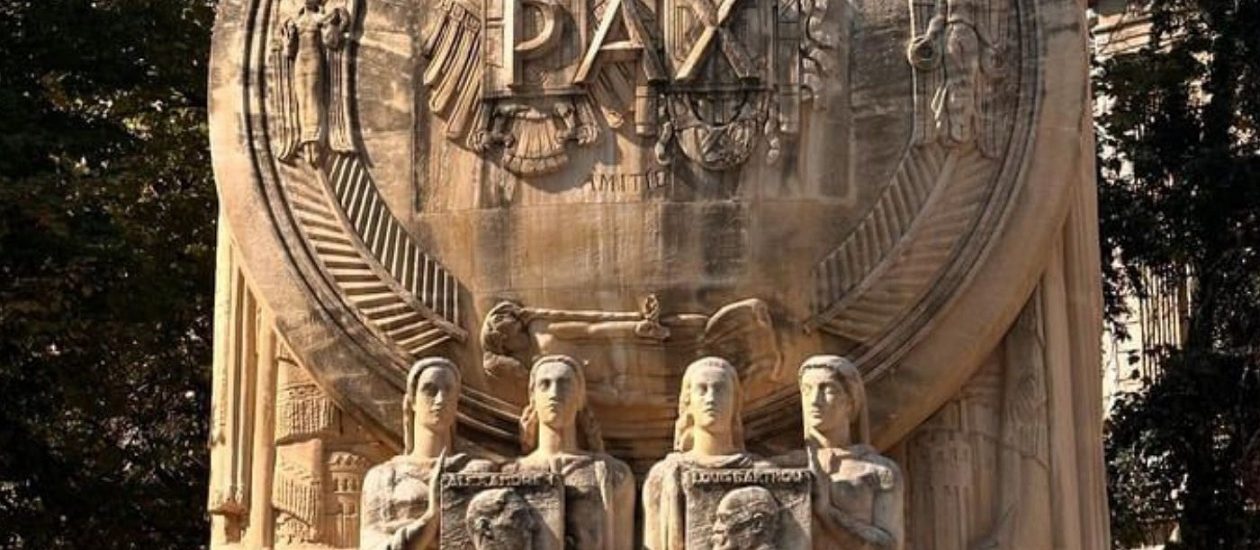
Unlike the Paris monument, which tells about the drama of the breakthrough of the Salonica Front, the monument in Marseille is distinguished by its allegorical nature – collective values expressed in stone. It consists of a complex sculptural-architectural unit comprising two columns filled with relief scenes of everyday life as well as representations of landmarks, modelled after Trajan’s Column in Rome. One is dedicated to Yugoslavia, and the other to France. A large circular surface in the form of a shield rests on the pillars, fully defined by the inscription PAX, which means peace, placed on the coats of arms of the Kingdom of Yugoslavia and the Republic of France. Just below the coats of arms the word Amitie (friendship) is inscribed. In addition to the inscription, there are relief personifications of Pain and Victory on the large shield. At the base of the shield there are four female figures attributed to the inscription on the pedestal – they embody the highly valued principles of Law, Justice, Freedom and Work; the first two hold the profile image of King Alexander I, and the second two the image of Minister Barthou.
Even a slightest disruption of order caused fear, and the mismatch between the field of experience after the Great War and the horizon of expectations in the haze of ever-increasing conflicts across Europe pushed France into the background of the world powers. The use of ritual practices and the installation of public monuments in the urban space of French cities, in the centre of which was the figure of the assassinated Yugoslav king, were to remind of the peace that the Entente powers won after the victory over the Central Powers. The death of King Alexander was seen as a sacrifice for the preservation of the peace and the Versailles order, and his memorization became an important point of the symbolic politics that was supposed to define an increasingly uncertain future.
The Origins: The Background for Understanding the Museum of Yugoslavia
Creation of a European type of museum was affected by a number of practices and concepts of collecting, storing and usage of items.

New Mappings of Europe
Museum Laboratory
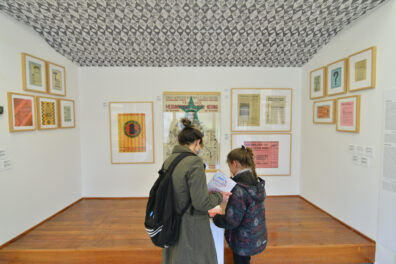
Starting from the Museum collection as the main source for researching social phenomena and historical moments important for understanding the experience of life in Yugoslavia, the exhibition examines the Yugoslav heritage and the institution of the Museum